
Digital Payment Orchestration Guide for Businesses
June 18, 2026
TL;DR:
- Payment orchestration centralizes the management of multiple payment providers through a single control layer to optimize transaction success. It evaluates transactions in real time, selecting the best provider and route to maximize authorization rates, reduce failures, and lower costs. Successful implementation requires technical and strategic preparation, choosing a flexible platform, and continuous monitoring to adapt routing rules and ensure optimal payment performance.
Payment orchestration is defined as a centralized technology layer that manages multiple payment providers, routing engines, and payment methods through a single control interface to maximize transaction success rates. This digital payment orchestration guide covers everything you need to build, configure, and maintain that layer effectively. Payment orchestration gives you one control layer over multiple providers so every transaction takes the best available path. Platforms like Sensepass, along with payment methods including PayPal, Klarna, and BitPay, represent the ecosystem you will be coordinating. The result is fewer failed transactions, lower processing costs, and a payment experience that works across every channel you operate.
How does digital payment orchestration work?
A production payment orchestrator sits between your checkout interface and your payment providers. It does not process payments directly. Instead, it evaluates each transaction in real time and decides which provider, method, and route gives that transaction the best chance of success.
A production payment orchestrator includes six functional layers: a routing engine, retry logic, a reconciliation engine, and observability tools for monitoring and alerting. Each layer handles a specific job in the transaction lifecycle. Together, they eliminate the manual coordination that would otherwise fall on your engineering team.
Here is how a transaction moves through the orchestration layer from start to settlement:
| Step | Orchestration Function |
|---|---|
| Checkout initiation | Captures payment method, amount, currency, and customer data |
| BIN inspection | Reads the card’s Bank Identification Number to identify issuer and geography |
| Routing rules evaluation | Applies smart routing logic based on BIN, currency, region, and provider availability |
| Provider selection | Ranks providers by historical authorization rate, latency, and cost |
| Authorization request | Sends the transaction to the top-ranked provider for approval |
| Soft decline handling | Detects soft declines and triggers automatic retry on a backup provider |
| Settlement | Confirms funds capture and logs the transaction across all systems |
| Unified reporting | Aggregates fees, disputes, and payouts from all providers in one dashboard |
Smart routing decisions evaluate BIN, currency, geography, customer segment, and provider availability to produce a ranked provider list with fallback options. That ranking happens in milliseconds. The customer never sees it.
Pro Tip: Configure your routing rules to weight historical authorization rates at least as heavily as processing cost. A cheaper provider that declines 15% more transactions costs you more in lost revenue than it saves in fees.
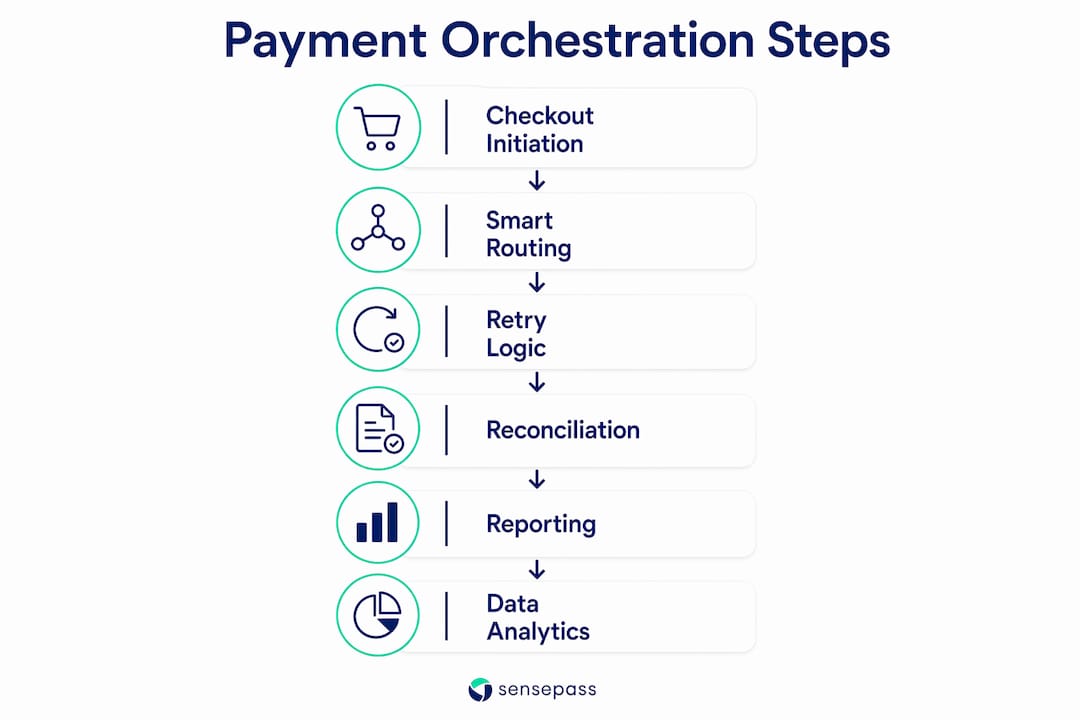
Unified reporting across providers simplifies reconciliation and financial monitoring significantly. Instead of logging into five separate provider dashboards, your finance team works from one source of truth.
What prerequisites do you need before implementing orchestration?
Getting orchestration right starts before you write a single line of integration code. Businesses that skip the prerequisites phase typically discover gaps mid-deployment, which is far more expensive to fix.
Technical prerequisites
Your backend systems must be able to communicate via REST APIs or webhooks. Most modern orchestration platforms, including Sensepass, expose a single unified API that maps to each provider’s specific interface. Orchestration platforms map one consistent API to many provider-specific APIs, which cuts ongoing engineering maintenance significantly. Your team needs to be comfortable with API authentication, token management, and error handling before integration begins.
You also need a secure server environment with TLS 1.2 or higher, PCI DSS compliance readiness, and logging infrastructure capable of capturing transaction events at every step.
Strategic prerequisites
On the business side, you need active agreements with at least two payment processors before orchestration adds value. One provider gives you nothing to route between. You also need clarity on which payment methods your customers actually use, because that shapes which connectors you configure first.
Here is a checklist of must-have items before you adopt an orchestration platform:
- Active contracts with two or more payment processors
- PCI DSS compliance program in place or underway
- REST API integration capability in your development team
- Defined list of required payment methods (cards, wallets, BNPL, crypto, bank pay)
- Analytics or BI tooling to measure authorization rates and decline reasons
- A clear understanding of your transaction volume by region and currency
Choosing the right platform
Vendor-agnostic orchestration platforms keep your processor options open and preserve your negotiation leverage. Avoid platforms that lock you into a proprietary processor network. Sensepass is processor-agnostic and connects to 50+ card processors, which means you retain full flexibility to negotiate rates and switch providers without rebuilding your integration. Sensepass also supports digital wallets like Apple Pay, Google Pay, PayPal, Venmo, WeChat, Alipay, and Amazon Pay, BNPL options including Klarna, Sezzle, ZIP, Splitit, and Afterpay, financing through WeGetFinancing and Affirm, crypto via BitPay and Coinbase, and Pay by Bank through Trustly and LinkMoney.
Pro Tip: Before signing with any orchestration vendor, ask specifically whether their routing engine is configurable by your team or managed only by the vendor. Configurable routing gives you the ability to react to provider performance changes without waiting on vendor support.
How to implement payment orchestration step by step
Implementation follows a predictable sequence. Skipping phases or running them in parallel creates testing gaps that surface as production failures.
The six implementation phases
- Planning. Map your current payment stack. Document every provider, every payment method, every region, and every failure mode you have experienced. This becomes your routing rule baseline.
- Platform selection. Evaluate orchestration vendors against your checklist from the prerequisites phase. Confirm API documentation quality, sandbox availability, and support for your required payment methods.
- API integration. Connect your checkout to the orchestration layer’s unified API. Because orchestration platforms abstract provider APIs into a single interface, you build one integration instead of one per provider.
- Routing rule configuration. Define your primary and fallback routing logic. Set rules by BIN range, currency, transaction amount, and geography. Assign fallback providers for each primary route.
- Testing. Run end-to-end tests in the sandbox environment covering successful authorizations, soft declines, hard declines, refunds, and partial captures. Test every payment method you plan to offer at launch.
- Launch and monitoring. Go live with a limited traffic percentage first. Monitor authorization rates, latency, and error codes in real time before expanding to full volume.
In-house vs. third-party orchestration: a direct comparison
| Factor | In-House Build | Third-Party Platform |
|---|---|---|
| Time to first transaction | 6–18 months | 4–12 weeks |
| Engineering cost | High, ongoing | Lower, predictable |
| Provider coverage | Limited by team capacity | Broad, pre-built connectors |
| Routing flexibility | Fully custom | Configurable within platform rules |
| Compliance maintenance | Your responsibility | Shared with vendor |
| Best for | Large enterprises with unique needs | Most businesses scaling payment operations |
Third-party platforms win on speed and coverage for the majority of businesses. In-house builds make sense only when your transaction volume and routing complexity exceed what commercial platforms support.
Pro Tip: During launch, configure your monitoring dashboard to alert on authorization rate drops greater than 2% within any 15-minute window. Catching a provider degradation early prevents significant revenue loss before your team would otherwise notice.
For a detailed look at retail payment workflows, Sensepass publishes a step-by-step guide covering orchestration in physical and digital retail environments.
What challenges arise with orchestration and how do you fix them?
Even well-planned orchestration deployments encounter operational friction. Knowing the common failure patterns in advance lets you build defenses before they become customer-facing problems.
The most common issues
Integration complexity is the top challenge at deployment. Each payment provider uses slightly different data formats, error codes, and authentication methods. An orchestration layer normalizes these differences, but your team still needs to validate that each connector behaves correctly under edge cases like partial authorizations and network timeouts.
Soft declines are a frequent source of lost revenue that orchestration is specifically designed to address. If a provider returns a soft decline, the platform auto-retries along backup routes without requiring the customer to re-enter payment details. Configuring your retry logic correctly is critical. Retrying a hard decline wastes time and can trigger fraud flags. Retrying a soft decline on the right backup provider recovers the sale.
Latency issues typically trace back to geographic routing mismatches. Sending a transaction from a customer in Southeast Asia to a processor based in Europe adds unnecessary round-trip time. Configure region-specific routing rules to keep transactions on local or regional provider infrastructure.
Here is a practical troubleshooting checklist for ongoing operations:
- Monitor authorization rates by provider, region, and payment method daily
- Log every decline reason code and categorize by soft vs. hard decline
- Review fallback trigger frequency weekly to identify underperforming primary routes
- Audit provider agreements quarterly to confirm rate structures match your routing priorities
- Test refund and dispute workflows monthly to catch reconciliation gaps early
- Avoid single-provider dependency for any high-volume payment method or region
For businesses operating in high-risk payment environments, specialized processors like DavinciPay offer processing solutions that integrate within an orchestration layer alongside standard providers.
Vendor lock-in is a risk that compounds over time. If your orchestration platform restricts which processors you can connect, your negotiating position weakens as your volume grows. Prioritize platforms with open connector architecture from the start.
Key takeaways
Payment orchestration succeeds when you combine a vendor-agnostic platform, well-configured routing rules, and continuous monitoring into a single operational discipline.
| Point | Details |
|---|---|
| Define your stack first | Document every provider, method, and region before selecting an orchestration platform. |
| Use vendor-agnostic platforms | Platforms supporting 50+ processors preserve your negotiation leverage and routing flexibility. |
| Configure smart routing carefully | Weight authorization rates alongside cost to maximize revenue, not just minimize fees. |
| Automate soft decline recovery | Auto-retry logic on backup routes recovers lost sales without customer friction. |
| Monitor continuously | Track authorization rates, latency, and decline codes daily to catch provider degradation early. |
Why orchestration is the infrastructure decision that compounds over time
I have seen businesses treat payment orchestration as a technical checkbox rather than a strategic asset. That framing costs them money every quarter. The businesses that get the most out of orchestration are the ones that treat routing rules as a living configuration, not a one-time setup.
The most underrated benefit of orchestration is not the failover logic or the unified API. It is the data. When every transaction from every provider flows through one layer, you accumulate a clear picture of where your payment stack is underperforming. That data gives you leverage in processor negotiations, clarity in product decisions, and early warning on fraud patterns.
I am also watching AI-driven routing become a real differentiator. Static rule-based routing works, but platforms that use machine learning to adjust provider rankings based on real-time authorization signals are starting to outperform manual configurations by measurable margins. That gap will widen.
My honest advice: do not build in-house unless you have a genuinely unique routing problem that commercial platforms cannot solve. The engineering cost of maintaining provider connectors, compliance updates, and retry logic is relentless. A platform like Sensepass, with pre-built integrations across NetSuite, Oracle Xstore, Shopify POS, Aptos, NCR, Dynamics365, and more, compresses months of integration work into weeks. That time is better spent on your core product.
The businesses winning at payments right now are not the ones with the most providers. They are the ones with the best visibility into how those providers perform and the infrastructure to act on that data quickly.
— Vlad
How Sensepass powers your payment orchestration strategy
Sensepass is built specifically for businesses that need to accept payments across multiple channels without rebuilding their stack for every new provider or method.
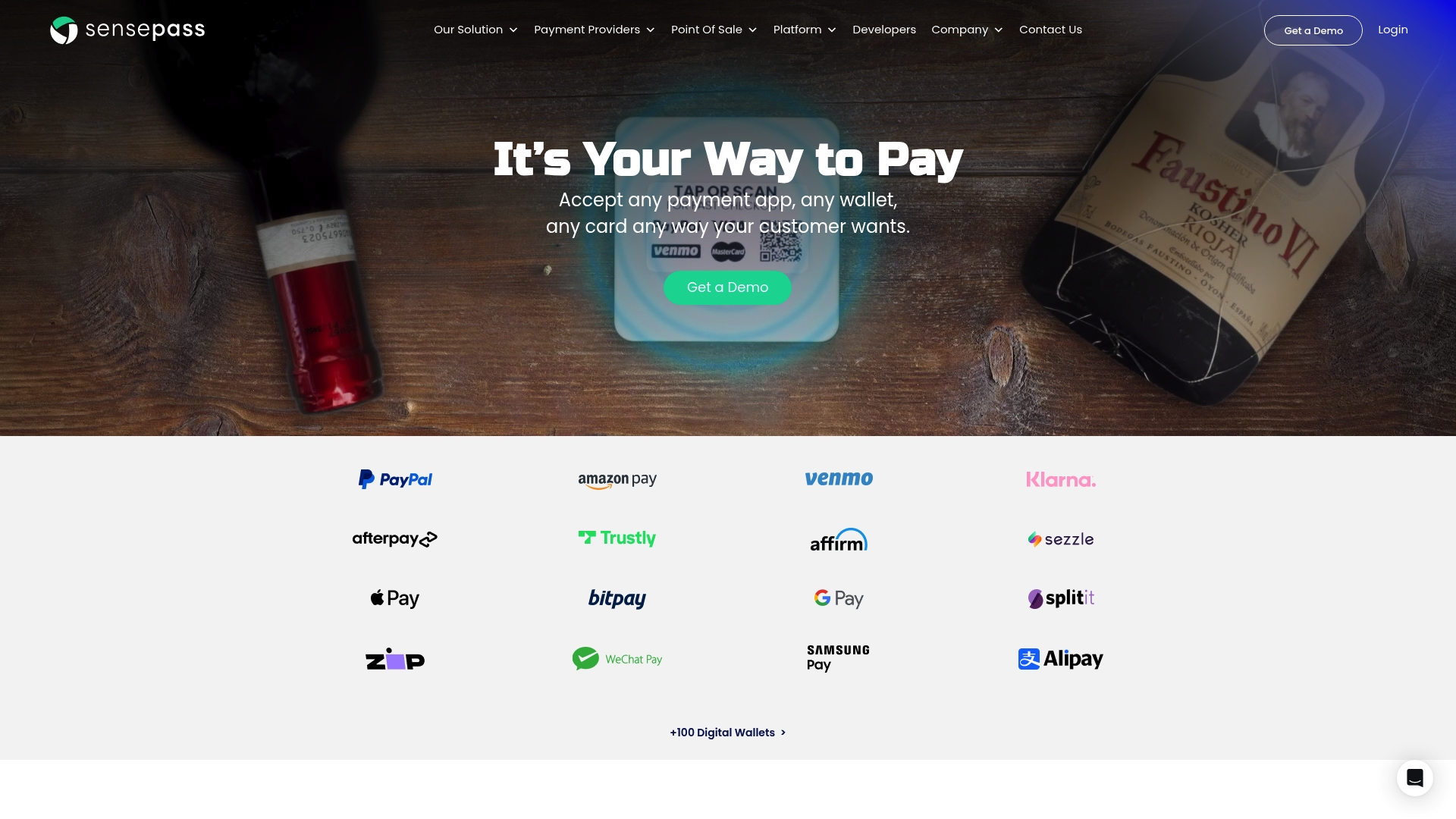
Sensepass is processor-agnostic and connects to 50+ card processors, giving you full control over routing and rate negotiation. It integrates with major platforms including NetSuite, SuiteCommerce, Oracle Xstore, Aptos, Shopify POS, BigCommerce, Storis, NCR, and Dynamics365. On the payment method side, Sensepass supports digital wallets (PayPal, Venmo, Apple Pay, Google Pay, WeChat, Alipay, Amazon Pay), BNPL options (Klarna, Sezzle, ZIP, Splitit, Afterpay), financing (WeGetFinancing, Affirm), crypto (BitPay, Coinbase), and Pay by Bank (Trustly, LinkMoney). For retailers building a complete omnichannel payments strategy, Sensepass provides the orchestration layer, the provider connections, and the analytics to keep your payment operations performing at their best.
FAQ
What is payment orchestration in simple terms?
Payment orchestration is a control layer that sits between your checkout and your payment providers, routing each transaction to the best available provider in real time. It handles routing, retries, and reporting across all providers from one interface.
How does smart routing improve authorization rates?
Smart routing evaluates BIN data, currency, geography, and provider availability to select the provider most likely to approve a given transaction. This reduces unnecessary declines and increases overall authorization rates without any action required from the customer.
Do i need multiple payment processors to use orchestration?
Orchestration delivers its full value when you have at least two active processor agreements, because the routing and fallback logic requires options to route between. A single processor gives the orchestration layer nothing to optimize.
What is the difference between a payment gateway and an orchestration layer?
A payment gateway connects your checkout to one processor. An orchestration layer connects your checkout to many processors and manages routing, retries, and reconciliation across all of them from a single API.
How long does it take to implement payment orchestration?
Using a third-party platform, most businesses complete integration and go live within 4–12 weeks. In-house builds typically require 6–18 months and significantly higher engineering investment.
Recommended
- Mastering the Omnichannel Payment Workflow Guide – Omnichannel payments at the Point Of Sale | Sensepass
- Master Payment Processing Best Practices for Your Business – Omnichannel payments at the Point Of Sale | Sensepass
- How to start a payment processing business in 2026 – Omnichannel payments at the Point Of Sale | Sensepass

 New York Office
260 Madison Ave Suite 8018 New York NY 10016

