
Optimize retail mobile payments workflow: boost sales 35%
March 24, 2026
Retailers today face mounting pressure from fragmented mobile payment systems that disrupt sales and frustrate customers at critical checkout moments. Disjointed workflows create transaction delays, inconsistent payment options across channels, and missed revenue opportunities that directly impact your bottom line. Retail mobile payments workflow optimization is no longer optional for businesses seeking competitive advantage in omnichannel retail. This comprehensive guide walks you through proven strategies to assess your current infrastructure, integrate payment orchestration with popular POS systems, secure transactions, and continuously monitor performance for maximum ROI.
Table of Contents
- Key takeaways
- Assess current payment systems and customer touchpoints
- Integrate payment orchestration with POS systems
- Implement security and compliance best practices
- Test, optimize, and monitor mobile payment workflows
- Explore SensePass solutions for omnichannel payments
- Frequently asked questions
Key Takeaways
| Point | Details |
|---|---|
| Assess current payments | Create a complete inventory of every payment method and map where customers interact with payments across channels. |
| Integrate with POS systems | Choose a payment orchestration platform that unifies online, in store and mobile transactions and works with your POS environment. |
| Security and compliance | Implement strong security measures and maintain compliance to protect payment data and customer information. |
| Monitor and optimize workflows | Continuously monitor performance and optimize payment workflows to boost conversion rates and return on investment. |
Assess current payment systems and customer touchpoints
Before optimizing your retail payment workflow process, you need a complete picture of your existing payment infrastructure and where customers interact with it. Start by creating a detailed inventory of every payment method and technology deployed across all channels. Document in-store terminals, mobile apps, web checkout systems, and any alternative payment options currently available.
Map your customer journey to identify every point where payments occur or could be enhanced. Track transactions from initial product browsing through final purchase completion, noting where customers abandon carts or encounter friction. This mapping reveals critical optimization opportunities you might otherwise overlook. Pay special attention to cross-channel transitions, like customers who browse on mobile but complete purchases in-store.
Identify specific pain points causing transaction failures or customer frustration. Common issues include slow authorization times, limited payment method choices, inconsistent experiences between channels, and confusing checkout interfaces. Quantify these problems with metrics like abandonment rates, average transaction times, and customer service complaints related to payments.
Evaluate hardware and software compatibility before planning integrations. Your existing POS terminals, card readers, and backend systems must support modern payment technologies or require upgrades. Check whether current infrastructure can handle contactless payments, digital wallets, and emerging methods like BNPL without complete replacement.
Pro Tip: Engage frontline staff for feedback on payment friction points to gain practical insights that data alone cannot reveal. Cashiers and sales associates witness customer frustrations daily and often identify workflow bottlenecks management misses.
Integrate payment orchestration with POS systems
Payment orchestration platforms transform fragmented payment acceptance into a unified system that works seamlessly across every channel. These solutions consolidate online, in-store, and mobile transactions through a single integration point, eliminating the complexity of managing multiple payment processors and gateways independently. Payment orchestration unifies channels and supports 100+ methods, integrating with POS systems like NetSuite, Oracle Xstore, and Shopify POS.
Ensure your chosen orchestration platform supports the full spectrum of payment methods modern customers expect. Digital wallets including Apple Pay, Google Pay, PayPal, and Venmo have become standard expectations, not premium features. BNPL options like Klarna, Afterpay, Sezzle, and ZIP attract younger demographics and increase average order values. Contactless NFC payments deliver the speed and convenience that drive customer satisfaction scores higher.
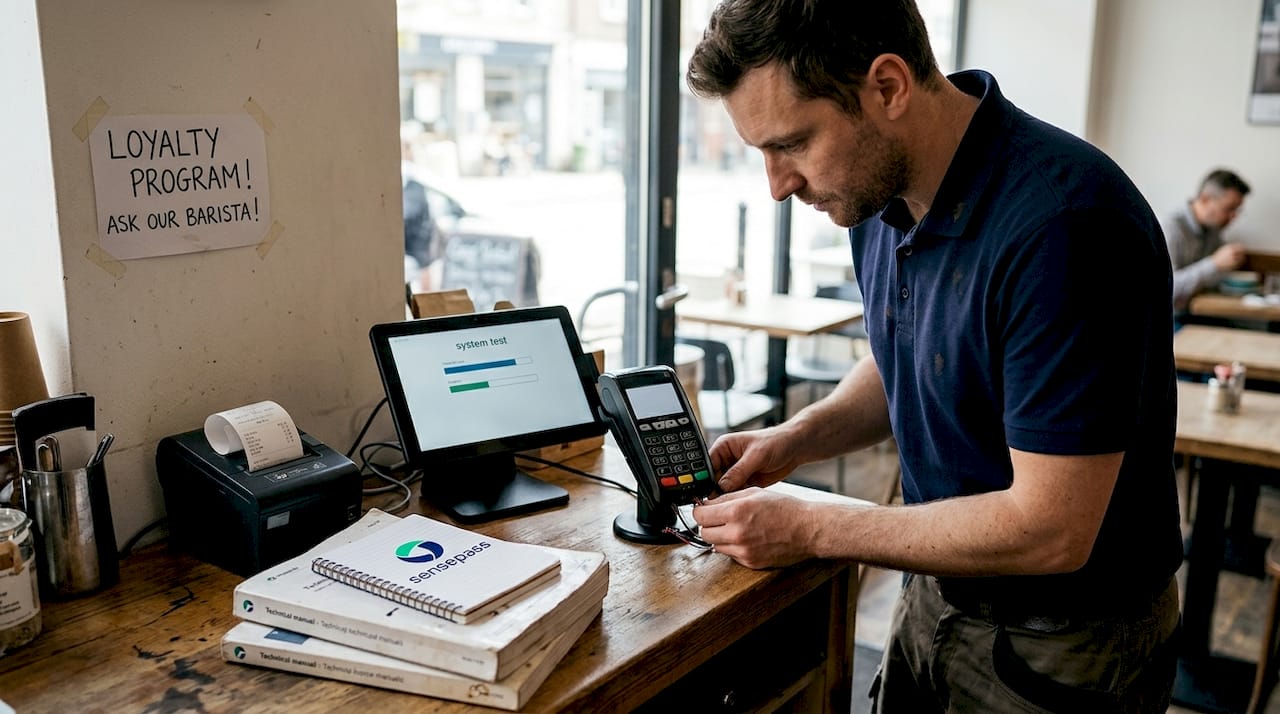
Choose hardware-agnostic solutions that integrate smoothly with your specific POS ecosystem. Whether you operate on Shopify POS, Lightspeed, NewStore, or legacy systems, your orchestration platform should connect without forcing expensive hardware replacements. Flexibility in processor selection prevents vendor lock-in and gives you negotiating power on transaction fees.
| Platform Feature | SensePass | Traditional Gateway | Legacy POS |
|---|---|---|---|
| Omnichannel support | Yes, unified | Limited | Store only |
| Payment methods | 100+ including wallets, BNPL, crypto | 10-20 card types | Credit/debit cards |
| POS compatibility | NetSuite, Oracle, Shopify, Aptos, NCR, Dynamics365 | Select partners | Proprietary |
| Processor options | 50+ processors | 1-3 processors | Single processor |
| API integration | Developer-friendly REST APIs | Varies | Often none |
Prioritize platforms offering seamless API connectivity to minimize manual configuration and reduce implementation errors. Well-documented APIs with robust SDKs accelerate integration timelines from months to weeks. Look for solutions providing pre-built connectors for your specific POS system to avoid custom development costs.
Processor-agnostic orchestration gives you freedom to optimize costs and performance continuously. When you can switch between 50+ card processors based on transaction fees, authorization rates, and regional performance, you maintain control over your payment economics. This flexibility becomes crucial as your business scales across markets with different payment preferences. Review payment gateway selection tips to understand evaluation criteria beyond basic functionality.
Modern orchestration platforms also enable intelligent payment routing based on transaction characteristics. Route high-value purchases through processors with better fraud detection, send international transactions to gateways with favorable cross-border fees, and direct mobile wallet payments through optimized pathways. This dynamic routing improves authorization rates while reducing processing costs. Understanding mobile POS overview helps contextualize how orchestration enhances mobile-specific workflows.
Implement security and compliance best practices
Security compliance forms the foundation of trustworthy payment operations that protect both your business and customers. Implementing security and compliance includes PCI DSS and tokenization to safeguard transactions against evolving threats. PCI DSS compliance is not optional; it is a mandatory standard for any business handling payment card data, with penalties for non-compliance ranging from fines to loss of payment processing privileges.
Deploy tokenization to eliminate sensitive data exposure during transactions. Tokenization replaces actual card numbers with randomly generated tokens that have no exploitable value if intercepted. This approach dramatically reduces your PCI compliance scope because you never store or transmit real payment credentials. Modern orchestration platforms handle tokenization automatically, removing this burden from your internal systems.
Regularly update software and conduct vulnerability assessments to stay ahead of emerging security threats. Payment systems become targets for sophisticated attacks that exploit outdated code and unpatched vulnerabilities. Establish quarterly security audits and implement automated patch management for all payment-related infrastructure. Schedule penetration testing at least annually to identify weaknesses before criminals do.
Train staff on security policies and teach them to recognize fraud attempts in real-time. Human error causes more breaches than technical failures, making employee education your first line of defense. Conduct monthly training sessions covering phishing recognition, social engineering tactics, and proper handling of payment disputes. Create clear escalation procedures so staff know exactly how to respond when suspicious activity occurs.
Enforce multi-factor authentication and encryption for all mobile payment endpoints. Mobile devices present unique security challenges because they operate outside your controlled network perimeter. Require biometric authentication or PIN codes before processing transactions, and ensure all payment data transmits over encrypted connections. Implement remote wipe capabilities for lost or stolen devices containing payment applications. Explore comprehensive retail payment security tips to build defense-in-depth strategies.
Test, optimize, and monitor mobile payment workflows
Thorough testing prevents costly failures when you launch optimized payment workflows to real customers. Conduct phased testing of payment methods and integration points before full rollout, starting with internal transactions, then expanding to limited customer pilots, and finally deploying across all channels. This staged approach isolates problems early when they affect fewer transactions and customers.
Use performance metrics like transaction speed, conversion rate, and error rates to identify bottlenecks systematically. Track authorization times from payment initiation to approval, measuring separately for different payment methods and channels. Monitor decline rates by reason code to distinguish between legitimate fraud prevention and false positives that cost sales. Calculate cart abandonment at each checkout step to pinpoint exactly where customers exit.
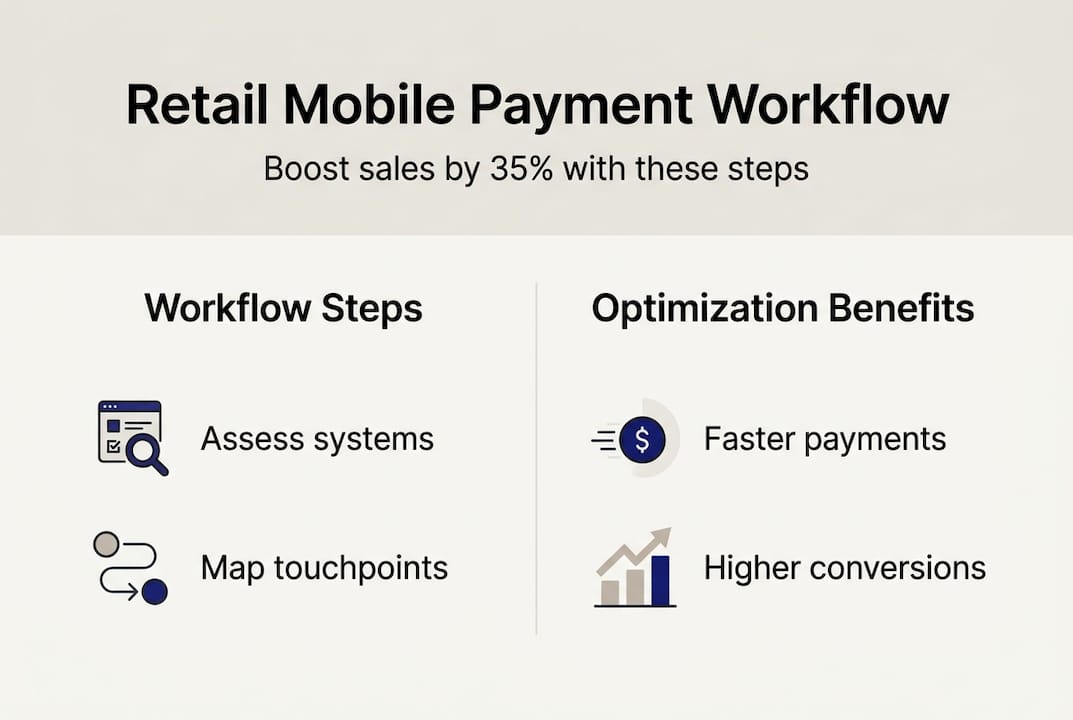
Employ A/B testing to compare checkout options and determine which configurations maximize conversions. Test app checkout against mobile web, one-click payment buttons versus traditional forms, and different payment method orderings. Run tests long enough to achieve statistical significance, typically requiring hundreds of transactions per variant. Small improvements in conversion rates compound into substantial revenue gains across thousands of daily transactions.
| Metric | Before Optimization | After Optimization | Revenue Impact |
|---|---|---|---|
| Mobile conversion rate | 2.1% | 2.8% | +35% mobile revenue |
| Average transaction time | 47 seconds | 18 seconds | Improved customer satisfaction |
| Cart abandonment rate | 68% | 52% | 16% more completed purchases |
| Payment authorization rate | 87% | 94% | 7% fewer false declines |
| Cross-channel consistency | 43% | 89% | Unified customer experience |
Testing and optimizing can raise conversions by 35%, and monitoring yields 9.5% revenue increase with 566% ROI in year one. These improvements accumulate over time as you continuously refine workflows based on real performance data.
Establish continuous monitoring and feedback loops to adapt workflows dynamically:
- Set up real-time dashboards tracking key payment KPIs across all channels and locations
- Configure automated alerts for anomalies like sudden decline rate spikes or processing delays
- Schedule weekly reviews of payment performance data with stakeholders from operations, IT, and finance
- Collect customer feedback specifically about payment experiences through post-purchase surveys
- Benchmark your metrics against industry standards to identify improvement opportunities
- Implement changes incrementally and measure impact before scaling successful optimizations
- Document lessons learned and update standard operating procedures based on findings
Pro Tip: Leverage analytics dashboards to track mobile payment adoption and customer preferences, revealing which payment methods drive the highest conversion rates and average order values for your specific customer base. Understanding mobile payment technology trends helps you anticipate which emerging methods deserve testing priority.
Monitoring should extend beyond technical metrics to business outcomes. Track how payment optimization affects customer lifetime value, repeat purchase rates, and net promoter scores. Customers who experience frictionless payments return more frequently and spend more per transaction. Connect payment performance directly to revenue growth to justify continued investment in workflow improvements.
Explore SensePass solutions for omnichannel payments
Optimizing your mobile payment workflow requires the right technology partner who understands retail complexity. SensePass delivers payment orchestration solutions specifically designed for seamless omnichannel operations, integrating with major platforms including NetSuite, SuiteCommerce, Oracle Xstore, Aptos, Shopify POS, BigCommerce, Storis, NCR, and Dynamics365. Our processor-agnostic approach gives you access to 50+ card processors, ensuring you maintain control over costs and performance.
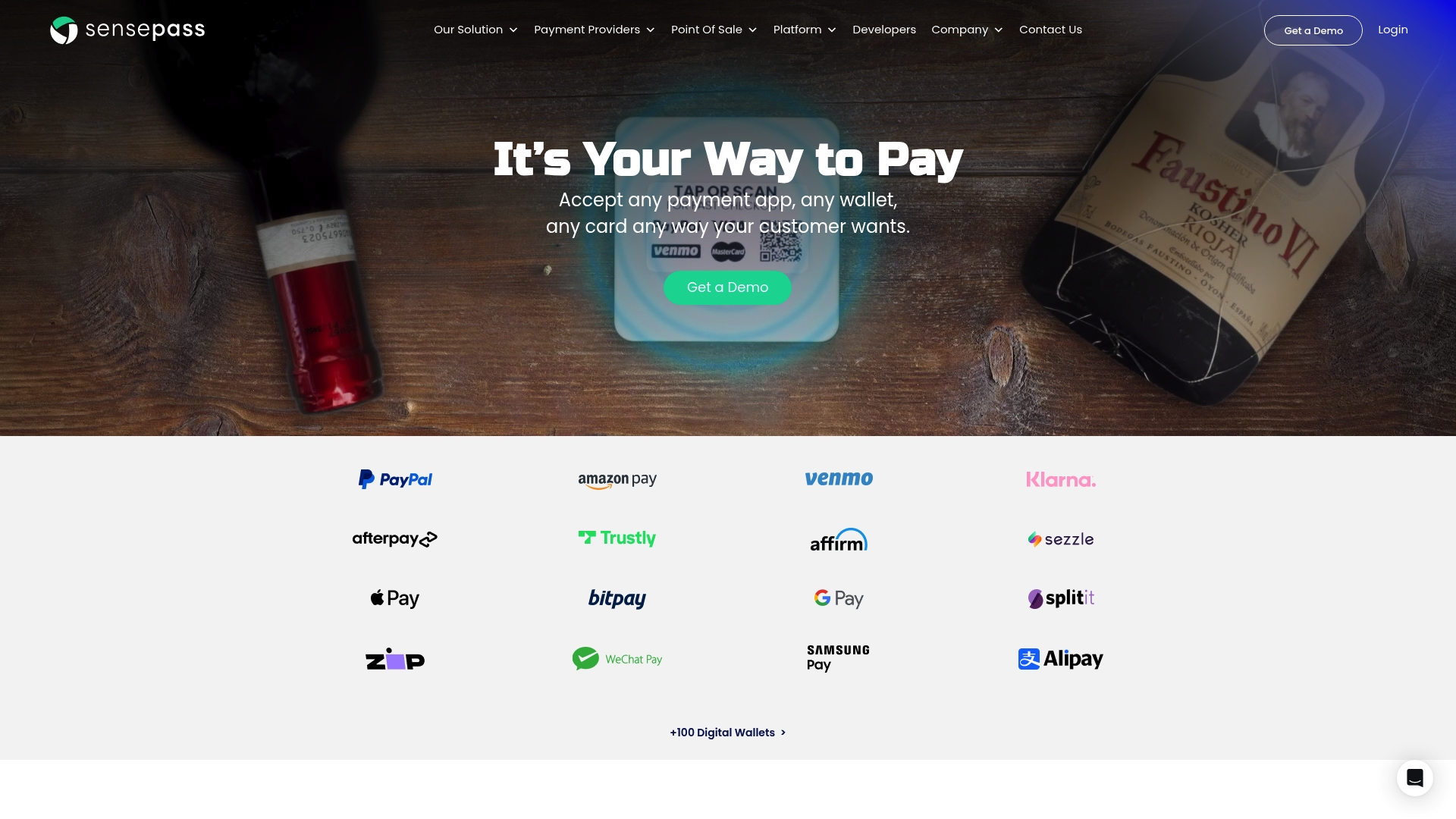
SensePass supports an extensive range of payment methods your customers demand. Accept digital wallets like PayPal, Venmo, WeChat, Apple Pay, Google Pay, Alipay, and Amazon Pay alongside BNPL options including Klarna, Sezzle, ZIP, Splitit, and Afterpay. Offer financing through WeGetFinancing and Affirm, crypto payments via BitPay and Coinbase, plus pay by bank through Trustly and LinkMoney. This comprehensive method support positions your business to meet diverse customer preferences across demographics and geographies. Explore our omnichannel payments guide to understand implementation strategies, review payment gateway selection tips for choosing the right solution, and discover alternative payment methods Shopify POS supports through SensePass integration.
Frequently asked questions
What is the typical retail mobile payments workflow?
The retail payment workflow process includes assessing current systems, integrating payment methods through orchestration platforms, securing transactions with compliance protocols, testing and optimizing configurations, and establishing ongoing monitoring. This systematic approach ensures smooth customer experiences across in-store, mobile, and online channels while maximizing authorization rates and minimizing friction. Each workflow stage builds on previous steps to create a cohesive payment ecosystem that adapts to changing customer preferences and technology capabilities.
How do payment orchestration platforms benefit retail businesses?
Orchestration platforms consolidate payment acceptance across all channels, supporting numerous payment types through a single integration point. They simplify connections with POS systems like Shopify POS, Lightspeed, and NetSuite while improving workflow efficiency through intelligent routing and unified reporting. Retailers gain flexibility to add new payment methods without complex technical work, reduce processing costs through competitive processor selection, and deliver consistent customer experiences regardless of purchase channel. Review payment gateway selection tips to evaluate platforms effectively.
Why is security compliance critical for mobile payments?
Compliance protects sensitive payment data and prevents fraud that damages customer trust and business finances. Tokenization reduces risk by replacing actual card information with secure tokens during transactions, ensuring intercepted data has no exploitable value. PCI DSS standards mandate specific security controls that minimize breach probability and limit liability when incidents occur. Non-compliance results in fines, increased processing fees, and potential loss of payment acceptance privileges. Implementing comprehensive retail payment security tips creates defense layers that protect against evolving threats.
How long does payment workflow optimization typically take?
Optimization timelines vary based on current infrastructure complexity and desired end state, typically ranging from 6 to 16 weeks for complete implementation. Initial assessment and planning require 2 to 3 weeks, platform integration takes 3 to 6 weeks with modern APIs, security implementation adds 1 to 2 weeks, and testing phases span 2 to 4 weeks before full deployment. Phased rollouts extend timelines but reduce risk by validating changes incrementally. Working with experienced orchestration providers accelerates implementation through pre-built connectors and proven methodologies.
What metrics indicate successful payment workflow optimization?
Key success indicators include conversion rate improvements of 20% to 35%, reduced transaction times below 20 seconds, authorization rate increases above 92%, and cart abandonment decreases of 10 to 15 percentage points. Monitor customer satisfaction scores specifically related to checkout experiences, tracking whether payment friction complaints decline after optimization. Financial metrics like processing cost reductions, chargeback rate decreases, and overall revenue growth attributable to payment improvements demonstrate ROI. Successful optimization delivers measurable gains across technical performance, customer experience, and business outcomes within the first quarter post-implementation.
Recommended
- 7 Essential Mobile Payment Solutions List for Retailers – Omnichannel payments at the Point Of Sale | Sensepass
- Understanding Mobile Payment Advantages for Businesses – Omnichannel payments at the Point Of Sale | Sensepass
- 7 Key Benefits of Contactless Payments for Retail Stores – Omnichannel payments at the Point Of Sale | Sensepass
- Mobile Payment Trends 2025: What Retailers Must Know – Omnichannel payments at the Point Of Sale | Sensepass
- Performance Marketing Team | Multi‑Channel Paid Ads

 New York Office
260 Madison Ave Suite 8018 New York NY 10016

