
Payment Processor Differences – Impact on Retail Integration
January 23, 2026
Running a retail store in the United States means juggling everything from customer expectations to complex financial systems. When a shopper pays with a card, a digital wallet, or even a direct bank transfer, you rely on a behind-the-scenes system to move money where it needs to go. Understanding how payment processors quietly connect your register to the global financial system can help you make smarter decisions that improve transaction speed, reduce errors, and support the payment methods your customers expect.
Table of Contents
- What Are Payment Processors And How They Work
- Types Of Payment Processors For Retailers
- Core Features And Platform Integrations
- Supported Payment Methods: Variety And Flexibility
- Comparing Costs, Risks, And Compliance Factors
Key Takeaways
| Point | Details |
|---|---|
| Understanding Payment Processors | Payment processors verify and facilitate transactions, ensuring funds are transferred securely between customers and merchants. |
| Choosing the Right Processor | Selection should consider transaction fees, integration capabilities, and supported payment methods to align with customer preferences. |
| Core Features Matter | Essential features include real-time processing, fraud detection, and strong analytics to enhance efficiency and security. |
| Cost vs. Risk Management | Evaluate the total cost of ownership, including transaction fees and potential fraud losses, when choosing a processor. |
What Are Payment Processors and How They Work
A payment processor is the backbone of modern retail transactions. It’s the system that takes your customer’s payment information, verifies it’s legitimate, and moves money from their account into yours. Whether someone swipes a card, taps their phone, or enters their bank details, a payment processor is working behind the scenes to make that transaction happen in seconds. Think of it as the invisible middleman connecting your register to the global financial system.
Here’s how the machinery actually works. When a customer initiates a payment, the payment processor system collects their payment details and sends that information through multiple security checkpoints. First, it routes the transaction through anti-fraud verification systems that check for suspicious patterns or mismatched data. If everything looks clean, the processor communicates with the customer’s bank (the issuing bank) to confirm they have sufficient funds and that the account is in good standing. The issuing bank either approves or denies the transaction within milliseconds. Once approved, the processor sends confirmation back to your point of sale system, the transaction completes, and the customer receives their receipt. Behind that single swipe or tap, dozens of verification steps have already occurred.
The architecture of payment processing involves multiple layers working in concert. Front-end processors handle the initial authorization and customer-facing communication, connecting directly to card associations like Visa and Mastercard. Back-end processors manage settlement, which is the actual transfer of funds between the issuing bank and your merchant bank, typically coordinated through the Federal Reserve’s clearing system. This settlement process happens on a scheduled basis, often within one to two business days, which is why you don’t see money appear in your account instantly. The processor also handles reconciliation, matching transactions recorded on your end with those recorded by the banks to ensure accuracy and catch discrepancies.
When you’re selecting a payment processor for your retail business, processor choice matters because different processors offer varying fee structures, integration capabilities, fraud prevention tools, and support for different payment methods. Some specialize in high-volume retail environments, while others focus on online merchants or subscription billing. Your processor must connect seamlessly with your existing point of sale system and support the payment methods your customers actually use. If your customers expect to pay with digital wallets like Apple Pay, Google Pay, or PayPal, your processor needs to support those. If you serve international customers, your processor should handle multiple currencies and payment methods like WeChat Pay or Alipay. The right processor transforms payment acceptance from a bottleneck into a competitive advantage.
Pro tip: When evaluating processors, compare not just their transaction fees but also their settlement times, fraud prevention capabilities, and whether they integrate with your existing POS system without requiring expensive custom development.
Types of Payment Processors for Retailers
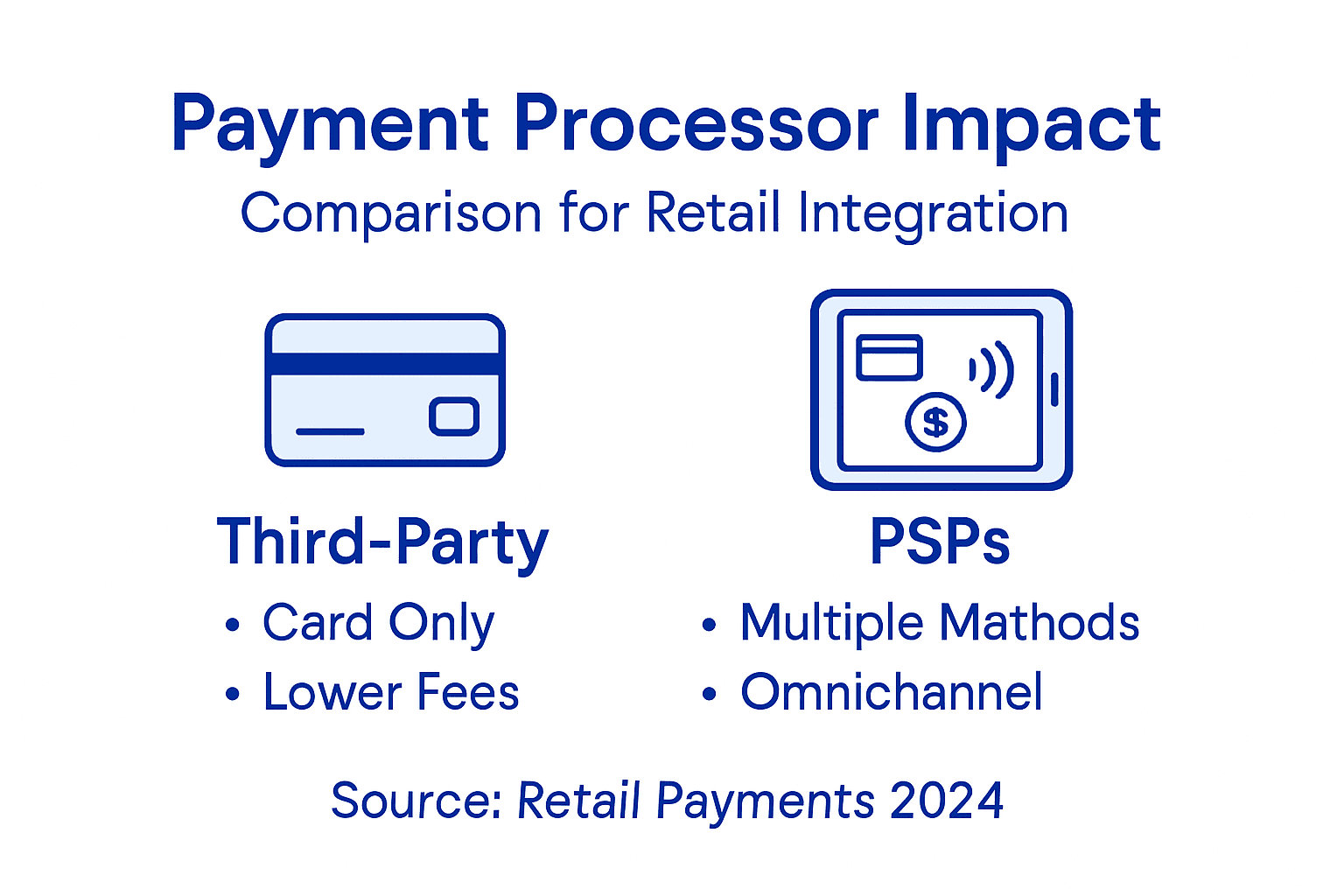
Not all payment processors work the same way, and understanding the different types helps you choose one that actually fits your business. The two main categories that matter to most retail owners are third-party payment processors (TPPPs) and payment service providers (PSPs). While these terms get used interchangeably sometimes, they represent different approaches to handling your transactions, and that difference affects everything from your fees to your flexibility to the payment methods you can accept.
Third-party payment processors are nonbank companies that handle credit card, ACH, debit, and prepaid card transactions for merchants like you. These processors operate by grouping transactions from multiple retailers together, which gives them economies of scale they can pass along through competitive pricing. Think of them as wholesale transaction handlers. They work with both brick-and-mortar stores and online retailers. The trade-off is that third-party payment processors aren’t typically regulated under the same rules as banks, which means they operate with different compliance requirements and oversight mechanisms. This doesn’t automatically mean less security, but it does mean you need to vet their fraud prevention and data protection measures carefully since your bank will monitor those relationships closely.
Payment service providers (PSPs) take a broader approach. Rather than just handling card transactions, PSPs facilitate digital wallets, bank transfers, and multiple payment methods all through one connection. They act as intermediaries between your store, acquiring banks, and payment networks like Visa and Mastercard. The advantage here is massive flexibility. With a PSP, you don’t need separate relationships with each bank or payment network. You connect to one platform, and it handles routing to whoever needs to process that specific transaction type. They typically offer integrated services like fraud detection, detailed reporting, and currency conversion all bundled together. Most PSPs charge per transaction or a flat monthly rate, and they handle the technical complexity so you don’t have to.
For retail businesses specifically, the choice often comes down to your transaction volume and the payment methods your customers demand. If you run a traditional retail store where customers primarily use cards and you have consistent monthly volume, a TPPP might offer better rates. If you’re running an omnichannel operation where customers expect to pay via Apple Pay, PayPal, Affirm, Klarna, or bank transfers both in store and online, a PSP built for omnichannel payments becomes essential. Some processors specialize in high-volume environments, others in subscription billing, and still others in international transactions. The right processor for your store depends on knowing your customer payment preferences first, then matching those needs to what each processor actually supports. For example, if your customers frequently use buy now pay later services like Klarna, Sezzle, or Afterpay, you need a processor that has built those integrations rather than trying to retrofit them yourself.
Here’s a side-by-side look at the two main types of retail payment processors:
| Aspect | Third-Party Payment Processors | Payment Service Providers (PSPs) |
|---|---|---|
| Transaction Methods | Primarily card and ACH payments | Card, bank, digital wallets, more |
| Integration Ease | May require separate setups | Single connection for multiple methods |
| Fee Structure | Often lower, aggregated pricing | Per transaction or flat monthly fee |
| Compliance Burden | Merchants watch compliance closely | PSPs cover many compliance aspects |
| Best For | Traditional, card-focused stores | Omnichannel or diverse payment needs |
Pro tip: Before committing to any processor, request a detailed breakdown of their transaction fees, settlement timeline, and which payment methods they support, then match that list against the payment options your customers actually use in your store.
Core Features and Platform Integrations
The difference between a payment processor that works smoothly with your business and one that creates constant headaches comes down to core features and how well it integrates with your existing systems. You could have the best transaction rates in the industry, but if your processor doesn’t connect with your POS system, your eCommerce platform, or your inventory management software, you’re looking at manual data entry, reconciliation errors, and wasted time. The processors that succeed in retail are the ones that understand your entire operation, not just the payment part.

Core features are the foundational capabilities every modern processor must deliver. Real-time transaction processing means payment authorization happens instantly, not hours later. Multi-channel integration allows customers to pay the same way whether they’re in your store, on your website, or ordering over the phone. Fraud detection and prevention should be automatic and sophisticated, catching suspicious activity without slowing down legitimate transactions. Detailed reporting and analytics lets you see not just how much money came in, but which payment methods your customers prefer, which locations perform best, and where you might be losing sales. PCI compliance and security certifications are non-negotiable because you’re handling sensitive payment information. Modern processors also need open banking capabilities, which means they can connect securely to your customers’ banks directly for verification and alternative payment methods. These aren’t optional add-ons anymore. They’re baseline expectations.
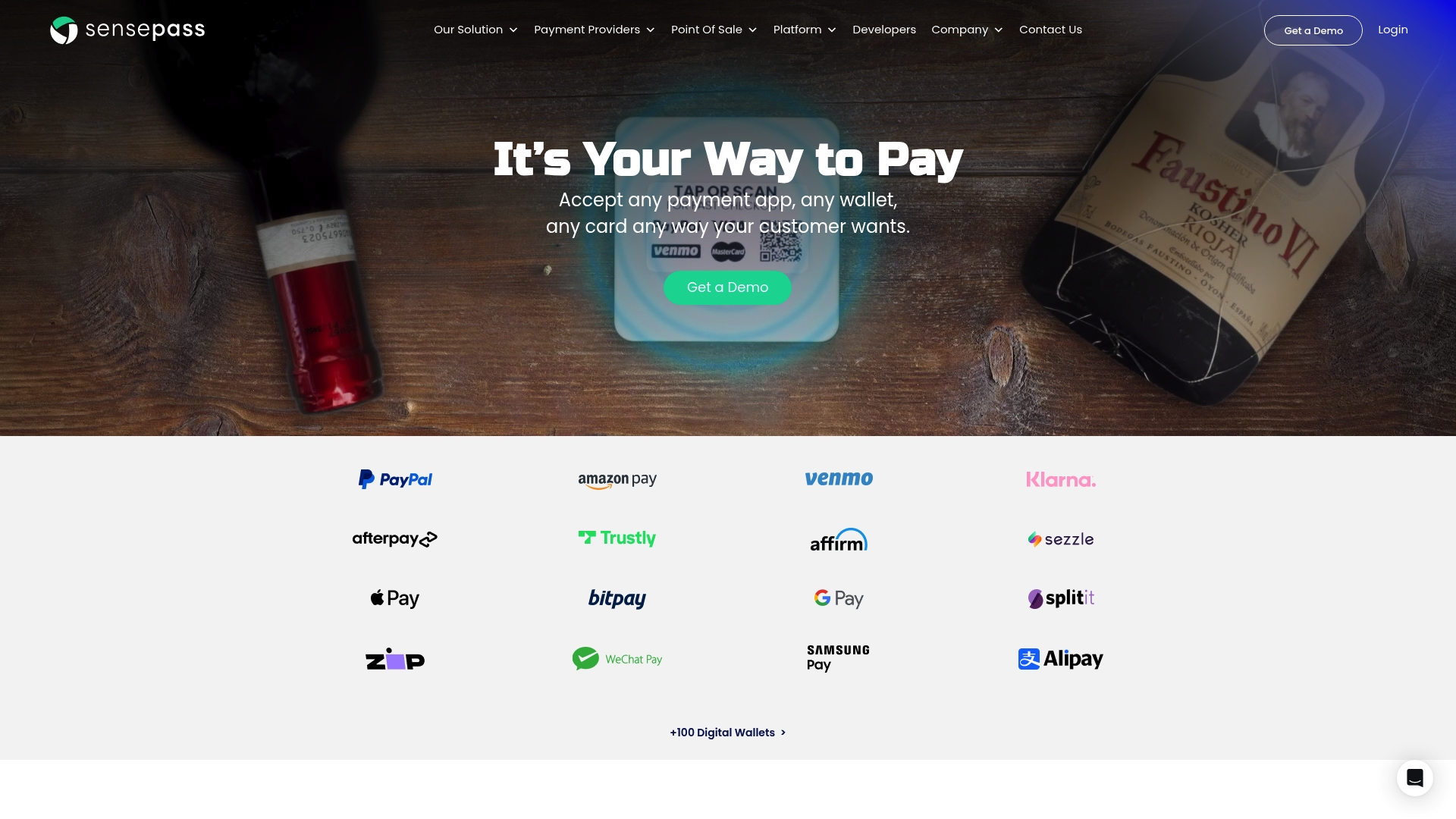
Platform integration is where the real value happens. SensePass, for example, integrates seamlessly with major POS systems like NetSuite, SuiteCommerce, Oracle Xstore, Aptos, Shopify POS, BigCommerce, Storis, NCR, and Dynamics365 among many others. This means your transactions flow automatically from your register into your accounting system, inventory updates in real-time, and reconciliation happens with minimal manual work. When a processor supports instant payment capabilities and real-time transaction processing integrated with your core systems, you eliminate the friction that slows down operations. But platform compatibility is only half the battle. You also need broad payment method support. If your processor only handles credit cards and ignores the fact that your younger customers want Apple Pay, Google Pay, or PayPal, you’re leaving money on the table. SensePass supports digital wallets like PayPal, Venmo, WeChat Pay, Apple Pay, Google Pay, Alipay, and Amazon Pay. It also handles buy now pay later services including Klarna, Sezzle, ZIP, Splitit, and Afterpay. For customers who prefer alternative financing, it supports WeGetFinancing and Affirm. For those interested in cryptocurrency, BitPay and Coinbase integration is available. Pay by bank options through Trustly and LinkMoney round out the ecosystem. Beyond that, SensePass is processor-agnostic, meaning you can choose from over 50 card processors for maximum flexibility rather than being locked into a single processor that might not offer competitive rates.
The integration challenge gets more complex when you’re running an omnichannel operation. Your in-store system, online store, mobile app, and call center need to share the same payment infrastructure and customer data. A processor that handles mobile payment integration across physical and digital channels with proper interoperability between payment methods becomes essential. You want unified reporting that shows you every transaction regardless of channel, consistent security compliance across all touchpoints, and seamless handoffs so a customer can start a transaction on their phone and complete it in your store without friction. Legacy systems complicate this. Many retailers still run older POS systems or accounting software that wasn’t designed for modern payment flexibility. The right processor provides modular architecture that can work with what you have now while allowing you to upgrade pieces without ripping everything out.
To clarify core features and their business impact, here is a summary:
| Feature | What It Delivers | Business Impact |
|---|---|---|
| Real-Time Processing | Immediate payment confirmation | Reduces waiting, speeds service |
| Multi-Channel Support | Accepts payments anywhere | Enables omnichannel selling |
| Fraud Prevention Tools | Detects and stops fraud quickly | Lowers financial and reputational risk |
| Analytics & Reporting | Detailed sales and method data | Informs business and marketing decisions |
| Processor Agnosticism | Supports many card processors | Offers flexibility and bargaining power |
Pro tip: When evaluating processors, create a list of every system your business uses (POS, eCommerce platform, accounting software, inventory management, loyalty program) and verify the processor supports direct integration with each one before signing any agreement.
Supported Payment Methods: Variety and Flexibility
Your customers don’t all pay the same way, and the moment your processor can’t handle their preferred payment method, you lose the sale. This isn’t theoretical. A customer ready to spend money abandons their purchase if they can’t use their digital wallet, their preferred buy now pay later option, or their bank app. The processors that win in retail understand this reality and support the broadest possible range of payment methods. The U.S. payment system now includes credit cards, debit cards, digital wallets, and ACH transfers, with emerging options like instant payments becoming increasingly common. Your processor needs to support all of these, not just the legacy payment methods.
SensePass demonstrates this principle through its payment method diversity. It supports digital wallets including PayPal, Venmo, WeChat Pay, Apple Pay, Google Pay, Alipay, and Amazon Pay. These aren’t niche options anymore. Apple Pay and Google Pay alone account for a significant portion of in-store transactions, particularly among younger shoppers. WeChat Pay and Alipay matter enormously if you serve Asian American customers or have international markets in your strategic plans. Buy now pay later (BNPL) services represent one of the fastest-growing payment categories. SensePass supports Klarna, Sezzle, ZIP, Splitit, and Afterpay. These options appeal to customers who want to manage their cash flow differently, and they consistently show higher conversion rates than traditional cards. Alternative financing options like WeGetFinancing and Affirm serve customers with specific needs, whether that’s purchasing power for larger transactions or serving customers who are building credit. Cryptocurrency payments through BitPay and Coinbase open your register to customers who hold digital assets. Pay by bank options through Trustly and LinkMoney enable direct bank transfers, which some customers prefer for security and lower perceived fees.
The breadth of payment method support directly impacts your bottom line. When payment providers support multiple card networks and diverse payment channels, they enable retailers to reach different customer segments and increase conversion rates. A customer who can’t use their preferred payment method becomes a lost transaction. A customer who can choose from eight different payment options feels like the merchant understands their needs. Beyond variety, flexibility matters in how payments are processed. Some customers want to pay online before pickup. Others want to order by phone and pay with a digital wallet. Still others want to pay in store with a contactless method. Your processor should handle all three scenarios seamlessly. Multi-currency support becomes essential if you ship internationally or have customers from different countries. Settlement speed varies by payment method, and your processor should clearly communicate which methods settle instantly versus next-day versus weekly.
One critical advantage SensePass brings to this conversation is processor agnosticism. Instead of locking you into a single card processor with fixed fees and limited negotiating power, SensePass allows you to choose from over 50 card processors. This flexibility means you can shop for competitive rates, find a processor that specializes in your industry, or even split processing across multiple providers if that makes economic sense. You’re no longer stuck with whoever your processor recommends. You control the relationship. As your business grows and your payment patterns shift, you can switch processors without replacing your entire payment infrastructure. This kind of flexibility transforms payment processing from a fixed constraint into a strategic advantage. Your processor should work for your business, not the other way around.
Pro tip: Analyze your actual transaction data to see which payment methods your customers actually use, then verify your processor supports those methods before committing, and revisit this quarterly since customer preferences evolve faster than most businesses expect.
Comparing Costs, Risks, and Compliance Factors
Choosing a payment processor based on transaction fees alone is like buying a car based only on gas mileage. You’re missing the full picture. The true cost of a processor includes transaction fees, platform fees, interchange charges, compliance expenses, and the hidden costs of fraud, chargebacks, and security failures. When you factor in regulatory compliance and risk management, some processors that look cheaper on paper actually cost significantly more when everything is counted. Understanding the complete financial picture requires comparing what you pay, what you’re protected against, and what legal obligations you’re responsible for.
Cost structures vary dramatically across processors. Some charge a percentage of each transaction (usually 2 to 3 percent for cards). Others charge a flat fee per transaction (typically 25 to 30 cents). Many use a hybrid model combining both. Then there are monthly platform fees, setup fees, early termination penalties, and fees for services like chargebacks or batch processing. Interchange costs, set by card networks, vary by card type and transaction category but aren’t negotiable by individual processors. What is negotiable is how transparent your processor is about these costs and whether they offer volume discounts as your business grows. The cheapest processor on day one might become expensive once you add in all the hidden fees. Processors that focus on omnichannel retail understand that you need different fee structures for in-store transactions versus online transactions, and they should offer pricing that reflects that reality. Some processors build compliance costs into their standard fees, which protects you, while others charge separately for compliance features.
Risk management is where processor choice becomes critical to your business survival. Fraud, money laundering, and operational failures represent significant risks that compliance standards address, and your processor must actively manage these threats. A good processor includes automatic fraud detection that blocks suspicious transactions in real-time without blocking legitimate ones. They handle chargeback management, which matters because every chargeback costs you money and damages your processor relationship. They maintain cybersecurity standards that protect your customer data. They provide transaction monitoring that flags unusual patterns. But here’s the critical part: you’re ultimately liable for fraud that occurs on your watch. Your processor shares responsibility, but not completely. A processor that saves you from one significant fraud event pays for itself many times over. When evaluating processors, ask specifically about their fraud prevention technology, their chargeback rate benchmarks, and their incident response procedures.
Compliance requirements aren’t optional, and they’re more complex than most retailers realize. PCI DSS compliance is mandatory for all merchants handling card payments, and non-compliance carries fines and reputational damage. The standard requires technical measures like encryption and network security, operational controls like strong access management, and regular audits to prove ongoing compliance. Many payment processors handle much of this for you, embedding PCI DSS certification into their service. But you still need to understand what you’re responsible for. If you store customer data, you have additional obligations. If you operate internationally, you need to comply with regulations in those countries as well. The European Union’s GDPR is increasingly relevant even for United States retailers serving European customers. Some processors include compliance support; others leave you to figure it out. A processor that provides compliance documentation, audit support, and regular security certifications reduces your legal risk significantly. Beyond PCI DSS, anti-money laundering (AML) compliance applies, particularly for processors themselves, but you need to understand how your processor helps you stay compliant with AML obligations.
The relationship between cost and risk mitigation isn’t linear. The most expensive processor isn’t automatically the safest, and the cheapest isn’t automatically dangerous. What matters is evaluating the total cost of ownership. Calculate your expected fraud losses, regulatory compliance costs, and operational expenses under different processors. Consider that a processor with better fraud prevention might cost more upfront but save you money through fewer chargebacks and fewer compliance violations. A processor with better integration capabilities saves you operational time and reduces manual data entry errors. Processor choice should reflect your risk tolerance, your transaction volume, your compliance requirements, and your growth trajectory.
Pro tip: Request each processor candidate to provide their fraud statistics, chargeback rates, and compliance certifications in writing, then calculate your projected total cost including fees, fraud losses, and compliance support before making your final decision.
Simplify Retail Payment Processing with SensePass
Understanding the impact of payment processor differences on retail integration reveals common challenges like complex system compatibility, limited payment method support, and hidden costs that slow business growth. If you are struggling with fragmented payment channels or worried about missing sales because your current processor does not support popular digital wallets or buy now pay later options, you are not alone. Retailers today need flexible, omnichannel payment solutions that handle a broad spectrum of payment types and integrate seamlessly with their existing platforms.
SensePass addresses these pain points by offering a processor-agnostic payment gateway that works effortlessly with major POS and eCommerce systems including NetSuite, SuiteCommerce, Oracle Xstore, Aptos, Shopify POS, BigCommerce, Storis, NCR, Dynamics365 and many more. It supports an extensive range of payment methods such as digital wallets like PayPal, Venmo, WeChat, Apple Pay, Google Pay, Alipay, Amazon Pay; BNPL options including Klarna, Sezzle, ZIP, Splitit, Afterpay; financing solutions like WeGetFinancing and Affirm; crypto payments via BitPay and Coinbase; and convenient pay by bank options through Trustly and LinkMoney. This flexibility empowers retailers to offer the payment choices customers expect while avoiding costly processor lock-ins.
Ready to transform your retail payment experience and streamline omnichannel sales?
Explore how SensePass can upgrade your payment infrastructure today. Visit SensePass.com to see how effortless integration and wide payment acceptance can boost your sales and operational efficiency now.
Frequently Asked Questions
What are the key differences between third-party payment processors and payment service providers?
Third-party payment processors primarily handle card and ACH payments, often providing lower fees through aggregated pricing. In contrast, payment service providers facilitate a broader range of payment methods, including digital wallets and bank transfers, offering more flexibility and integrated services.
How do payment processors enhance security and fraud prevention for retail businesses?
Payment processors employ sophisticated fraud detection systems to monitor transactions in real-time, identify suspicious patterns, and block fraudulent activities while ensuring legitimate transactions proceed without delays.
Why is platform integration important when choosing a payment processor for retail?
Effective platform integration allows payment processors to connect seamlessly with your existing point of sale, eCommerce platform, and inventory management system, minimizing manual data entry and reducing errors, which enhances overall operational efficiency.
How can supported payment methods impact customer satisfaction in a retail setting?
A diverse range of supported payment methods ensures that customers can use their preferred payment options, such as digital wallets or buy now pay later services, ultimately increasing conversion rates and customer satisfaction, as customers are less likely to abandon transactions due to limited payment options.
Recommended
- Payment Integration: Complete Guide for Retailers – Omnichannel payments at the Point Of Sale | Sensepass
- Payment Processing Fees Breakdown for Retailers – Omnichannel payments at the Point Of Sale | Sensepass
- Payment Gateway vs Processor: Complete Breakdown – Omnichannel payments at the Point Of Sale | Sensepass
- Complete Retail Payment Integration Tutorial for 2025 – Omnichannel payments at the Point Of Sale | Sensepass

 New York Office
260 Madison Ave Suite 8018 New York NY 10016

