
Role of Payment Gateways: Complete Retail Guide
October 31, 2025
Over 80 percent of shoppers expect fast and seamless payment experiences whether buying in-store or online. If your retail business stumbles at the checkout, you risk losing both sales and customer trust. Payment gateways have become the essential link making secure transactions possible by connecting stores, banks, and shoppers so every sale flows smoothly. Knowing how these systems work is key to building a safer and more flexible way for people to pay.
Table of Contents
- Defining Payment Gateways In Retail Environments
- Types Of Payment Methods Supported By Gateways
- How Payment Gateways Integrate With Pos And Platforms
- Security, Compliance, And Fraud Protection Measures
- Costs, Flexibility, And Choosing The Right Provider
Key Takeaways
| Point | Details |
|---|---|
| Role of Payment Gateways | Payment gateways are essential for securely connecting retailers, customers, and financial institutions during digital transactions, enabling efficient and safe online payments. |
| Integration with POS Systems | Effective integration with point-of-sale systems enhances transaction processing efficiency across multiple channels, adapting to the evolving retail technology landscape. |
| Security Measures | Security features like end-to-end encryption and compliance with PCI DSS are critical for protecting sensitive customer data and building trust in payment processing. |
| Choosing a Provider | When selecting a payment gateway, businesses should evaluate transaction fees, security features, and scalability to align with their operational needs and growth objectives. |
Defining Payment Gateways in Retail Environments
A payment gateway serves as the critical technological bridge connecting retailers, customers, and financial institutions during digital transactions. According to Salesforce, a payment gateway is a service that authorizes and processes online credit card or e-wallet payments, acting as a secure intermediary between the customer and merchant.
In retail environments, payment gateways function like digital cash registers, securely capturing and transmitting transaction data across multiple channels. Stripe describes these platforms as technology intermediaries enabling businesses to accept, process, and manage various payment methods efficiently and securely. These systems are not just transaction processors but comprehensive financial communication networks.
Key functions of payment gateways in retail settings include:
- Encrypting sensitive payment information
- Verifying customer payment credentials
- Routing transaction data to appropriate financial networks
- Providing real-time transaction authorization
- Supporting multiple payment methods
Modern payment gateways like SensePass have evolved beyond simple transaction processing. They now offer comprehensive payment gateway best practices that integrate seamlessly with point-of-sale systems, supporting everything from traditional credit card payments to emerging digital wallet technologies across in-store, online, and mobile platforms.
Types of Payment Methods Supported by Gateways
Payment gateways have dramatically expanded the range of transaction methods available to modern retailers. Oracle highlights that these systems now support a comprehensive array of payment types, including credit cards, debit cards, cash, physical gift cards, invoices, and store credit. Each of these methods comes with specific transaction capabilities like authorization, void, refund, and balance inquiry.
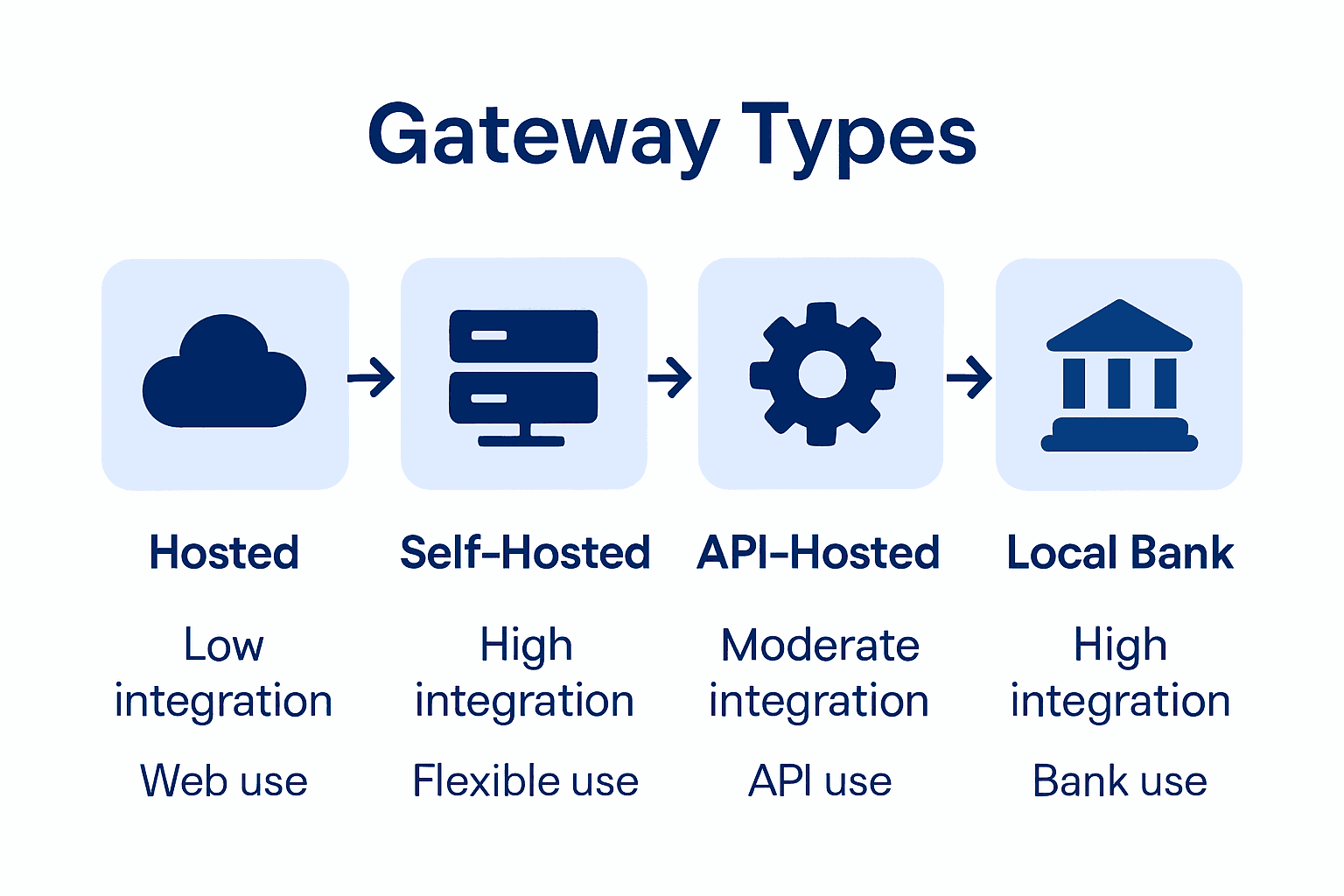
The technological landscape of payment processing has evolved to support multiple transaction types across different platforms. MoneyLion identifies several gateway integration models, including hosted payment gateways, self-hosted payment gateways, API-hosted payment gateways, and local bank integration gateways. These models offer businesses varying levels of control and technical integration.
Here’s a summary comparing the main types of payment gateways and their key features:
| Gateway Type | Integration Level | Control for Merchant | Typical Use Case |
|---|---|---|---|
| Hosted | Low | Minimal | Small businesses, quick setup |
| Self-hosted | Medium | Moderate | Customizable online stores |
| API-hosted | High | Extensive | Scalable e-commerce platforms |
| Local bank integration | Medium | Dependent on bank | Brick-and-mortar retailers |
Modern payment gateways support an extensive range of payment methods:
- Digital wallets (Apple Pay, Google Pay)
- Credit and debit cards
- Bank transfers
- Cryptocurrency payments
- Buy Now, Pay Later (BNPL) options
- Peer-to-peer payment platforms
SensePass takes this a step further by exploring the most advanced payment gateway types, ensuring retailers can access a flexible, comprehensive payment ecosystem that meets diverse customer preferences and technological requirements. The goal is to provide seamless, secure transaction experiences across multiple channels and payment instruments.
How Payment Gateways Integrate With POS and Platforms
Payment gateway integration represents a critical technological bridge connecting retail systems with financial transaction networks. Wikipedia explains that semi-integrated POS systems strategically connect payment terminals with retail software, maintaining strict separation between payment information transmission and other systems to ensure robust security and regulatory compliance.
Stripe highlights that modern payment gateways can seamlessly integrate with in-person transaction systems, including point-of-sale terminals, to facilitate electronic transactions across physical retail environments. This integration allows businesses to process payments efficiently and securely across multiple channels.
Key integration strategies include:
- API-driven connections
- Direct platform plugins
- Middleware solutions
- Webhook-based synchronization
- Real-time transaction routing
For retailers seeking comprehensive integration solutions, SensePass offers a detailed payment gateway integration guide that helps businesses navigate the complex landscape of technological connectivity. The goal is to create a unified, secure, and flexible payment ecosystem that adapts to evolving retail technology and consumer preferences.

Security, Compliance, and Fraud Protection Measures
Payment gateway security is the critical backbone of modern digital transactions. Salesforce emphasizes that a secure payment gateway protects sensitive customer financial data, builds crucial customer trust, and ensures compliance with Payment Card Industry Data Security Standard (PCI DSS), which is essential for processing card payments.
Stripe highlights the technical mechanisms of payment security, explaining that payment gateways perform sophisticated encryption of payment data, establish secure connections with payment processors, and manage transaction authorization to ensure secure, efficient, and accurate financial exchanges.
Key security and compliance measures include:
- End-to-end data encryption
- Tokenization of sensitive payment information
- Multi-factor authentication
- Real-time fraud detection algorithms
- Compliance with international security standards
Businesses looking to enhance their payment security can explore comprehensive payment security guidelines that provide in-depth strategies for protecting financial transactions and maintaining customer confidence in an increasingly complex digital payment landscape.
Costs, Flexibility, and Choosing the Right Provider
Payment gateway selection represents a critical strategic decision for businesses navigating the complex digital transaction landscape. MoneyLion recommends that companies carefully evaluate multiple factors when choosing a provider, including security features, support for multiple payment methods, global transaction capabilities, integration complexity, competitive pricing structures, and the quality of customer support.
Stripe emphasizes the financial considerations, noting that payment gateways typically charge transaction-based fees, and businesses must meticulously assess these costs alongside the gateway’s comprehensive feature set and operational compatibility with their specific business model.
Key evaluation criteria for selecting a payment gateway include:
- Transaction fee structures
- Integration complexity
- Supported payment methods
- Security and compliance features
- Scalability potential
- Customer support responsiveness
For retailers seeking a comprehensive provider evaluation framework, SensePass offers a detailed payment gateway checklist that helps businesses navigate the intricate process of selecting a payment solution aligned with their unique operational requirements and growth objectives.
Unlock Seamless Payment Experiences with SensePass
The article highlights common struggles retailers face when managing multiple payment methods and integrating complex payment gateways across diverse sales channels. If you are aiming to simplify omnichannel payments, boost conversion rates, and maintain robust security compliance, SensePass offers a flexible solution built exactly for these challenges. Designed as a processor-agnostic orchestration layer, SensePass connects flawlessly with leading POS systems like NetSuite, Oracle Xstore, Shopify POS, Aptos, and more. It supports a broad spectrum of payment options including top digital wallets like Apple Pay and Venmo, BNPL solutions such as Klarna and Afterpay, crypto payments, and bank transfers.
SensePass empowers your retail business by delivering a unified payment ecosystem that adapts effortlessly to changing consumer preferences and technological demands. This means faster checkout, reduced operational headaches, and a superior customer experience across online and in-store platforms.
Discover how to transform your payment infrastructure today with SensePass and learn more about our payment gateway integration guide to simplify complex setups.
Experience the future of retail payments now and stay ahead of the competition with a solution built to maximize flexibility, security, and efficiency.
Ready to upgrade your payment systems and increase sales?
Explore the possibilities at https://sensepass.com and take control of your omnichannel payments with ease.
Frequently Asked Questions
What is a payment gateway and how does it work in retail environments?
A payment gateway is a service that authorizes and processes online payments, acting as a secure intermediary between the customer and merchant. It encrypts sensitive payment information and verifies customer credentials during transactions.
What types of payment methods do modern payment gateways support?
Modern payment gateways support a range of payment methods, including credit and debit cards, digital wallets (like Apple Pay and Google Pay), bank transfers, cryptocurrency payments, and Buy Now, Pay Later (BNPL) options.
How do payment gateways integrate with point-of-sale (POS) systems?
Payment gateways can integrate with POS systems through API-driven connections, direct platform plugins, middleware solutions, and webhook-based synchronization, allowing secure and efficient processing of transactions across physical retail environments.
What security measures do payment gateways implement to protect transactions?
Payment gateways implement several security measures, including end-to-end data encryption, tokenization of sensitive information, multi-factor authentication, and real-time fraud detection algorithms to ensure safe and compliant digital transactions.
Recommended
- Understanding the Payment Gateway Checklist for Businesses – Omnichannel payments at the Point Of Sale | Sensepass
- Understanding the Advantages of Payment Gateways – Omnichannel payments at the Point Of Sale | Sensepass
- Understanding Features of Payment Gateways for eCommerce – Omnichannel payments at the Point Of Sale | Sensepass
- Transform42 New

 New York Office
260 Madison Ave Suite 8018 New York NY 10016

