
Your Guide to Unified Payment Acceptance for Retailers
June 5, 2026
TL;DR:
- Unified payment acceptance consolidates all sales channels and methods into a single, centrally managed system, improving efficiency and reducing costs. It relies on three interconnected layers: a POS system, a payment gateway, and an orchestration layer that routes transactions across providers and methods; platforms like Shopify POS and Sensepass exemplify this integration. Compliance with PCI DSS v4.0 and supporting a broad spectrum of payment options, including digital wallets, BNPL, crypto, and pay-by-bank, are critical for secure and flexible operations.
Unified payment acceptance is the practice of consolidating every payment method and sales channel your business operates into a single, centrally managed system. For retailers and eCommerce businesses, this means one integration handles credit cards, digital wallets, buy now pay later options, and bank transfers whether the sale happens in-store, online, or through a call center. This guide to unified payment acceptance covers the technology stack you need, how to evaluate payment gateways, a phased implementation roadmap, and the compliance requirements that apply from day one. Platforms like Shopify POS and orchestration layers like Sensepass are the named anchors most retailers build around. Retailers using unified commerce on a single platform report 8.9% higher sales and 22% lower total cost of ownership compared to fragmented setups. That number reflects what happens when inventory, customer profiles, and payment routing stop living in separate silos.
What are the essential components of unified payment acceptance?
Unified payment acceptance, also called omnichannel payment integration in industry terminology, rests on three interdependent layers: your point-of-sale system, your payment gateway, and an orchestration layer that connects them across channels.
Point-of-sale systems are the foundation. Shopify POS supports unified inventory and customer profiles without nightly syncs, which is the technical detail that separates true unification from a patchwork of exports and imports. Shopify POS Lite is included with every Shopify plan; POS Pro costs $89 per month per location and unlocks cross-location returns and advanced fulfillment. If you operate multiple store locations alongside an online channel, the Pro tier is not optional in practice.
Payment gateways sit between your checkout and the financial institutions that authorize transactions. A gateway captures and transmits payment data with support for strong authentication protocols like 3D Secure, and it is evaluated on four criteria: cost structure, PCI compliance posture, scalability, and integration depth. The gateway is not just a technical component. It is a strategic decision that directly shapes what your customers can pay with and how much each transaction costs you.
Orchestration layers like Sensepass sit above the gateway and POS, routing transactions intelligently across payment methods and processors. This layer is what makes accepting PayPal, Apple Pay, Klarna, and BitPay through the same checkout experience technically feasible without building separate integrations for each.
| Component | Primary function | Example tools |
|---|---|---|
| POS system | Unifies in-store and online inventory, orders, and customer data | Shopify POS, Oracle Xstore, NCR, Aptos |
| Payment gateway | Authorizes and transmits transaction data securely | Processor-specific gateways, hosted payment pages |
| Orchestration layer | Routes payments across methods, processors, and channels | Sensepass |
| Compliance tooling | Tokenization, script monitoring, MFA enforcement | PCI DSS v4.0 certified tools |
Pro Tip: Tokenization replaces raw card data with a non-sensitive token at the point of capture. This reduces your PCI DSS scope significantly because tokenized data has no value to attackers even if intercepted.
How to choose the right payment gateway and POS integration
Choosing a gateway is not a commodity decision. Gateway selection directly impacts customer experience and operational efficiency, and the wrong choice creates technical debt that compounds as you add channels and payment methods.
The two primary gateway architectures are hosted and integrated. A hosted gateway redirects customers to a third-party payment page to complete the transaction. This reduces your PCI scope because card data never touches your servers, but it introduces a redirect that can hurt conversion rates. An integrated gateway keeps the customer on your checkout page throughout, which improves experience but increases your compliance obligations. Most mid-to-large retailers choose integrated gateways paired with tokenization to balance both concerns.
When evaluating gateways, apply these criteria in order:
- PCI DSS v4.0 compliance: The gateway must meet current standards. Future-dated PCI DSS 4.0 requirements became mandatory in March 2025, including multi-factor authentication and payment page script monitoring.
- Payment method breadth: Your gateway or orchestration layer must support the methods your customers actually use. Digital wallets like Apple Pay, Google Pay, PayPal, Venmo, WeChat, Alipay, and Amazon Pay now represent a significant share of transactions in most retail categories.
- BNPL and financing support: Klarna, Afterpay, Sezzle, ZIP, and Splitit each attract distinct buyer segments. Affirm and WeGetFinancing serve higher-ticket financing needs.
- Processor agnosticism: Locking into a single card processor limits your negotiating power on rates. Sensepass is processor-agnostic and connects merchants to 50+ card processors, which means you can route transactions to the processor offering the best rate for each card type.
- Platform compatibility: Your gateway must integrate cleanly with your existing eCommerce platform or ERP. Sensepass connects with NetSuite, SuiteCommerce, Oracle Xstore, Aptos, Shopify POS, BigCommerce, Storis, NCR, Dynamics365, and others without requiring custom middleware.
Pro Tip: Before signing a gateway contract, request a full list of supported payment methods and ask specifically about BNPL, crypto, and pay-by-bank options. Many gateways support cards well but require separate integrations for alternative methods, which defeats the purpose of unification.
For Shopify merchants, the payment processor selection process has its own nuances because Shopify Payments competes with third-party processors on the same platform. Understanding where third-party processors add value is worth the evaluation time.
How to implement unified payment acceptance step by step
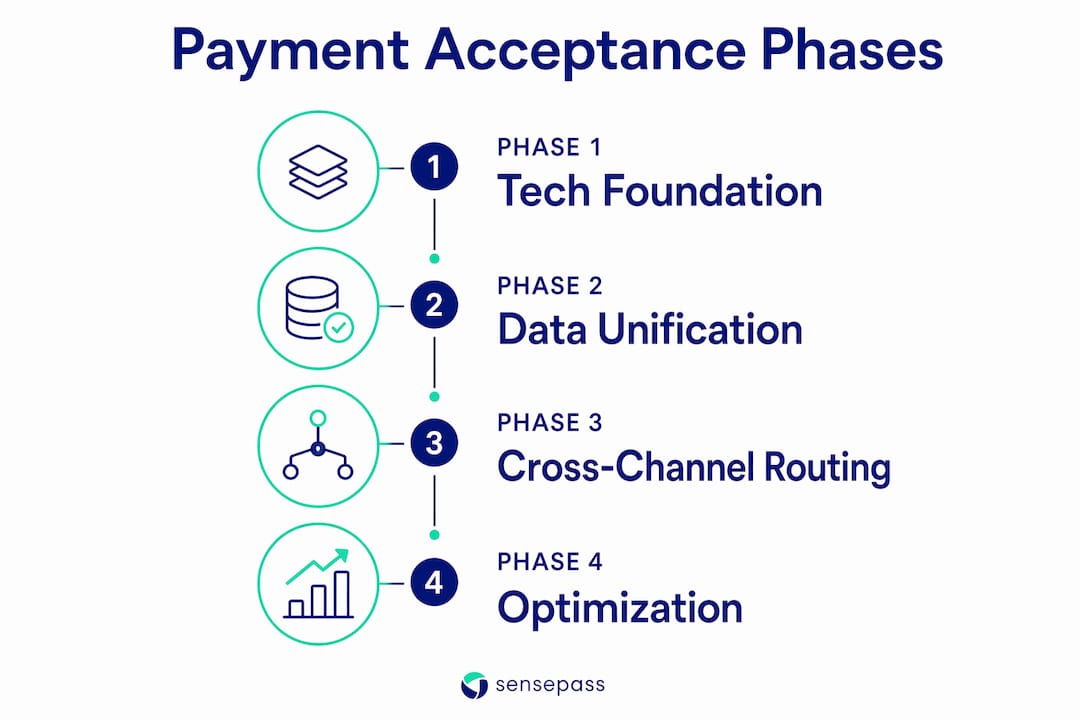
Implementation works best in four phases. Trying to unify everything at once typically results in data inconsistencies, compliance gaps, and a poor customer experience during the transition period.
Phase 1: Technology foundation
Start by auditing your current POS systems, eCommerce platform, and payment processors. Document every integration point where payment data flows. Migrate to a POS system that supports unified inventory and customer profiles natively. Activate all physical locations within the same platform instance so that inventory, returns, and customer records are shared in real time rather than synced on a schedule.
Phase 2: Customer data unification
Payment data and customer identity data must be linked. When a customer pays with Apple Pay in-store and PayPal online, both transactions should attach to the same customer record. This requires a unified customer profile layer, which Shopify POS and platforms like NetSuite SuiteCommerce provide natively. Segment your customer base by preferred payment method during this phase. The data will inform which payment methods to prioritize at launch.
Phase 3: Cross-channel payment routing
This is where the orchestration layer becomes critical. Payment lifecycle objects differ fundamentally from orders or inventory items. Transactions finalize after settlement, and each payment provider returns status updates in different formats. Your orchestration layer must map provider states consistently so that your accounting and reporting systems receive clean, reconciled data. Configure routing rules that direct transactions to the lowest-cost processor for each card type and geography.
Phase 4: Optimization and experience improvement
Once the system is live, connect a unified dashboard that shows transaction volume, authorization rates, and decline reasons across all channels and processors. Authorization rate is the metric most retailers underwatch. A 1% improvement in authorization rate on high-volume transactions translates directly to recovered revenue. Use decline reason data to adjust routing rules and identify payment methods where adding an alternative would reduce abandonment.
| Phase | Key action | Success metric |
|---|---|---|
| Technology foundation | POS migration, location activation, integration audit | All locations on one platform instance |
| Customer data unification | Unified profiles, payment method segmentation | Single customer record across channels |
| Cross-channel routing | Orchestration layer live, provider state mapping complete | Clean reconciliation data in accounting |
| Optimization | Dashboard live, routing rules tuned | Authorization rate improvement tracked |
Pro Tip: Run a parallel operation period of two to four weeks where both old and new systems process transactions simultaneously. Compare reconciliation outputs daily. This catches mapping errors before the old system is decommissioned.
For retailers connecting alternative payment methods to an existing Shopify setup, the Shopify POS integration process for alternative methods is a practical starting point.
What are the compliance and security challenges in unified payment acceptance?
Expanding your payment acceptance footprint expands your compliance obligations at the same rate. PCI DSS scope expands with every new script, API integration, or payment method you add, even when you use a PCI-certified gateway. The gateway’s certification covers the gateway. Your checkout page, your scripts, and your integrations remain your responsibility.
The PCI DSS v4.0 requirements that became mandatory in March 2025 introduce three obligations that directly affect unified payment implementations:
- Payment page script monitoring: Every script loaded on a payment page must be inventoried and monitored for unauthorized changes. Magecart-style attacks inject malicious scripts into payment pages to skim card data. PCI DSS v4.0 requires automated detection of script changes, not periodic manual review.
- Multi-factor authentication: MFA is now required for all access to the cardholder data environment, including administrative access to your POS management console and payment gateway dashboard.
- Expanded scope for cloud and API integrations: If your unified payment system connects to cloud-based ERP or CRM platforms, those connections fall within PCI scope and require documentation and controls.
Tokenization is the single most effective scope-reduction tool available to retailers. When card data is tokenized at capture and never stored in your systems, the majority of PCI requirements apply only to the tokenization service provider, not to your infrastructure.
Best practices for maintaining compliance as your payment acceptance grows:
- Conduct segmentation testing after every new integration to confirm that cardholder data environments remain isolated.
- Schedule annual penetration testing and quarterly vulnerability scans as a minimum cadence.
- Use hosted payment pages for lower-risk channels like call centers where the conversion rate impact of a redirect is minimal.
- Maintain a live inventory of all third-party scripts on payment pages and set automated alerts for any change.
Pro Tip: When you add a new payment method like crypto via BitPay or Coinbase, or pay-by-bank via Trustly or LinkMoney, treat each integration as a new PCI scope event. Document the data flow before go-live, not after.
The omnichannel payment tips that experienced retailers apply consistently include compliance checkpoints built into the integration process itself, not bolted on at the end.
Key takeaways
Unified payment acceptance succeeds when you build on a processor-agnostic orchestration layer, enforce PCI DSS v4.0 controls from the first integration, and connect every channel to a single customer and inventory record.
| Point | Details |
|---|---|
| Start with the right POS | Choose a platform like Shopify POS that unifies inventory and customer profiles natively across all locations. |
| Prioritize gateway flexibility | Use a processor-agnostic layer like Sensepass to access 50+ processors and avoid rate lock-in. |
| Support the full payment method spectrum | Include digital wallets, BNPL, financing, crypto, and pay-by-bank to reduce checkout abandonment. |
| Treat compliance as ongoing | PCI DSS v4.0 scope expands with every new integration; monitor payment page scripts continuously. |
| Measure authorization rates | Track authorization rates by channel and processor to identify and recover lost revenue. |
Why processor agnosticism is the decision most retailers get wrong
I have seen retailers spend months selecting a payment gateway based on the wrong criteria. They optimize for the lowest per-transaction rate on Visa and Mastercard and ignore everything else. Then they launch a BNPL option six months later and discover their gateway requires a separate contract, a separate integration, and a separate reconciliation feed. The cost of that fragmentation, in engineering time and accounting overhead, exceeds the rate savings many times over.
The retailers who get this right start with the orchestration layer, not the gateway. They ask: what is the full set of payment methods my customers will want over the next three years? Then they choose infrastructure that supports that full set from day one, even if they only activate a subset at launch. Sensepass is built on exactly this logic. The processor-agnostic architecture means you are not renegotiating your entire payment stack every time consumer preferences shift.
The emerging development worth watching is managed stablecoin settlement. Circle’s CPN Managed Payments provides a fully managed stablecoin platform that abstracts digital asset complexity behind a single integration. For retailers with cross-border volume, USDC settlement is becoming a real operational option, not a theoretical one. The compliance overhead that made crypto settlement impractical for most merchants is being absorbed by managed platforms. This is worth including in your three-year payment method roadmap now.
My practical advice: build your unified payment infrastructure to be wider than you currently need. The cost of adding a payment method to an orchestration layer is a configuration change. The cost of rebuilding your integration architecture to accommodate one is a project.
— Vlad
How Sensepass unifies payment acceptance across your channels
If you are ready to move from fragmented payment integrations to a single, manageable system, Sensepass is built for exactly that transition.
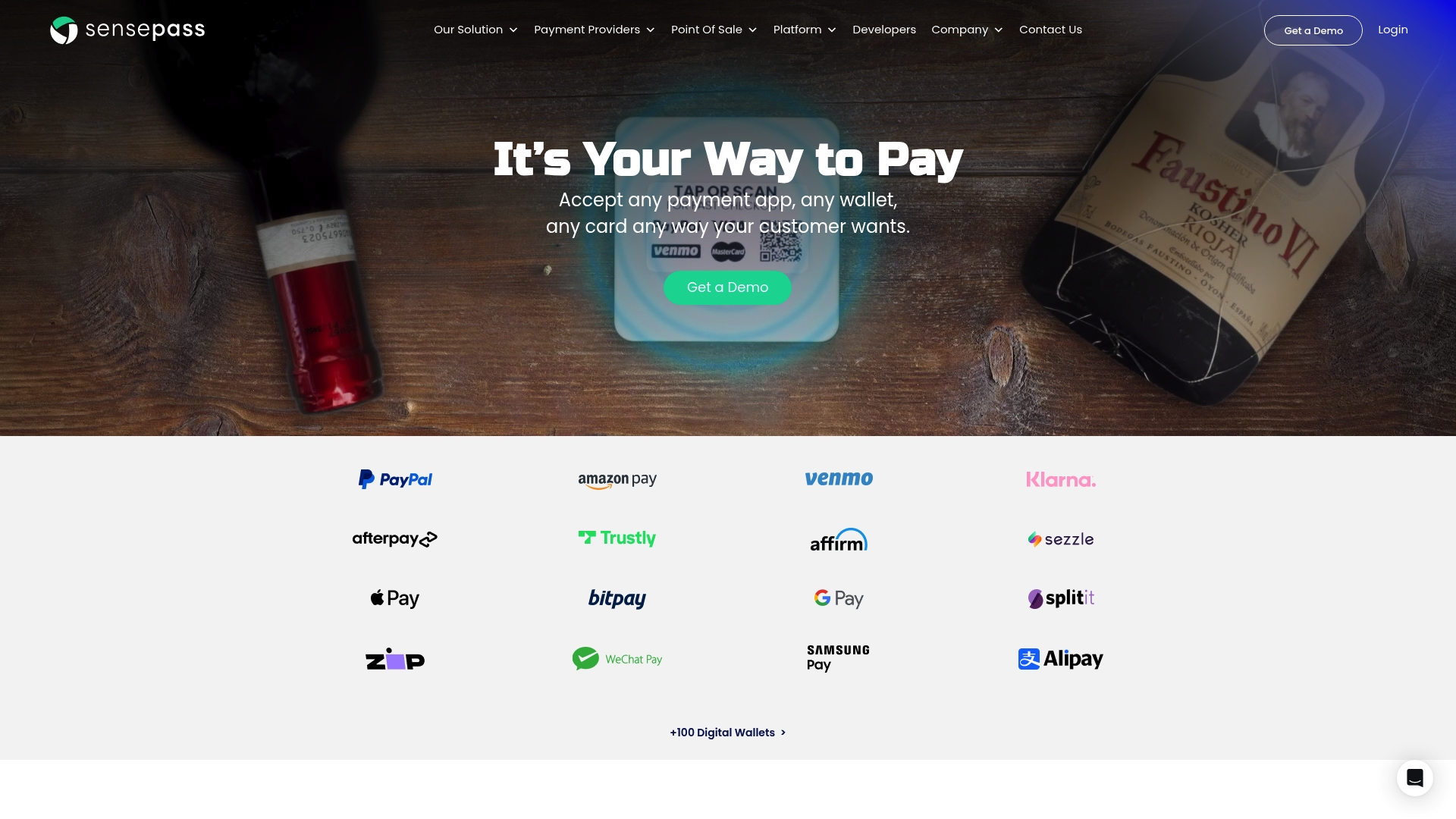
Sensepass operates as an orchestration layer and payment gateway connecting retailers to the full spectrum of payment methods through one integration. It works natively with NetSuite, SuiteCommerce, Oracle Xstore, Aptos, Shopify POS, BigCommerce, Storis, NCR, and Dynamics365. Payment method support covers digital wallets (PayPal, Venmo, WeChat, Apple Pay, Google Pay, Alipay, Amazon Pay), BNPL (Klarna, Sezzle, ZIP, Splitit, Afterpay), financing (WeGetFinancing, Affirm), crypto (BitPay, Coinbase), and pay-by-bank (Trustly, LinkMoney). The processor-agnostic architecture gives you access to 50+ card processors so you control your rates. Read the full omnichannel payments guide to see how retailers are putting this into practice.
FAQ
What is unified payment acceptance?
Unified payment acceptance is the integration of multiple payment methods and sales channels into one centrally managed system. It allows retailers to accept cards, digital wallets, BNPL, and other methods consistently across in-store, online, and call center channels.
How does a payment gateway differ from a payment orchestration layer?
A payment gateway authorizes and transmits transaction data between your checkout and financial institutions. An orchestration layer sits above the gateway and routes transactions across multiple gateways, processors, and payment methods based on cost, geography, or method type.
What does PCI DSS v4.0 require for unified payment systems?
PCI DSS v4.0 mandates payment page script monitoring, multi-factor authentication for cardholder data environment access, and expanded scope coverage for cloud and API integrations. These requirements became mandatory in March 2025.
Why is processor agnosticism important for retailers?
A processor-agnostic platform lets you route transactions to the lowest-cost processor for each card type and avoid being locked into a single provider’s rates. Sensepass connects to 50+ card processors, giving merchants direct control over processing costs.
Which payment methods should a unified system support?
A complete unified payment system covers credit and debit cards, digital wallets like Apple Pay and Google Pay, BNPL options like Klarna and Afterpay, financing through Affirm or WeGetFinancing, crypto via BitPay or Coinbase, and pay-by-bank through providers like Trustly. Supporting the full range reduces checkout abandonment across customer segments.
Recommended
- Essential Payment Gateway Selection Tips for Retailers – Omnichannel payments at the Point Of Sale | Sensepass
- Retail Payment Ecosystem Guide: Complete Overview – Omnichannel payments at the Point Of Sale | Sensepass
- Your Guide to Flexible Payment Options in Retail – Omnichannel payments at the Point Of Sale | Sensepass
- Master Payment Processing Best Practices for Your Business – Omnichannel payments at the Point Of Sale | Sensepass

 New York Office
260 Madison Ave Suite 8018 New York NY 10016

